‘𝘐𝘧 𝘢 𝘮𝘢𝘯 𝘤𝘢𝘯 𝘴𝘦𝘦 𝘵𝘩𝘦 𝘱𝘢𝘵𝘩 𝘢𝘯𝘰𝘵𝘩𝘦𝘳 𝘪𝘴 𝘸𝘢𝘭𝘬𝘪𝘯𝘨 𝘰𝘯 𝘩𝘦 𝘤𝘢𝘯 𝘱𝘦𝘳𝘤𝘦𝘪𝘷𝘦 𝘸𝘩𝘪𝘤𝘩 𝘥𝘪𝘳𝘦𝘤𝘵𝘪𝘰𝘯 𝘩𝘦 𝘸𝘪𝘭𝘭 𝘵𝘢𝘬𝘦.’
– Lewis Bernaldo de Quiros
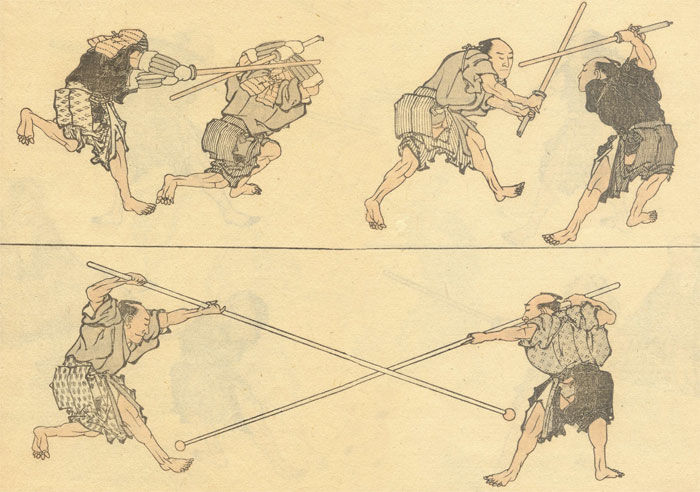
This is the line between your centre and that of your partner and represents his line of attack and hence the simplest spatial connection with him. This attack can take place directly along the line as in a shomen uchi attack, or take place off the line as in a yokomen uchi (representative of straight or circular attacks in general).
We have three basic options in dealing with an attack directed at us along or around this line.
- We can move off the line of attack and triangulate a second line to his centre directly and in the same timing as his attack (awase). A clear example of this is migi awase.
- We can stay on the line and ‘wedge’ into his attack. This is in fact another triangulation but involves a smaller movement and contact with the attacking weapon. This is obviously what we do in go no awase.
- A third option which we can appreciate more in Jo thrusting attacks is to ‘wedge’ off the line as we receive the attack. This is the initial blending movement that takes place in the Kumijo number 2 and is a more subtle movement involving a tight circular blend that defects the incoming attack while returning us directly to our attacker’s centre line. The same ‘wedging back’ movement takes place in Kumijo 3, 4, and 5 but with different technical responses.
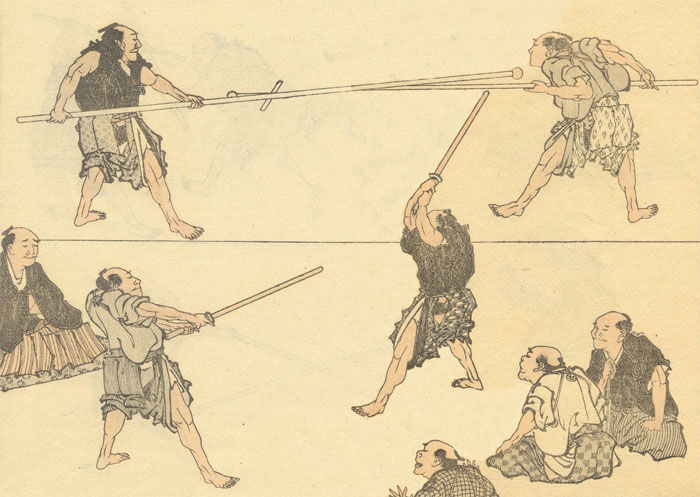
Understanding the dynamics of ‘line work’ in the context of distance, angle and timing is critical in that these are the basic spatial and temporal parameters of any encounter and understanding them deeply allows the Budoka to not only relate appropriately to an attack but also anticipate and read what is possible in a given situation and therefore control it before any attack takes place by either pre-empting or nullifying it, among other options.
– Reflections on the Motril Intensive 2018 – Lewis Bernaldo de Quiros
TO LEARN MORE ABOUT TAKEMUSU AIKIDO AND OUR
DAILY TRAINING EXPERIENCE VISIT THIS PAGE:
 TAKEMUSU AIKIDO ONLINE DOJO