Source: Aiki News #58 (October 1983)
There is a subject of considerable importance that we have dealt with on several occasions in this publication. I would like, however, to broach it again in a more systematic manner. I refer to the topic of aikido training injuries. When aikido is talked about in print, the focus seems to be more on the aspects of harmony, blending and spiritual matters and some of the more mundane areas revolving around practice in the dojo are easily neglected. These include the inevitable muscle strains, body soreness, jammed toes and fingers and the various other “occupational” hazards inherent to our art. They are forgotten, that is, until that inevitable day when we ourselves become the victims of an injury and must live with the accompanying pain.
Common Training Injuries
What are the common aikido injuries? How are they likely to occur? I’ll list some of those that immediately spring to mind along with their usual causes and readers can compare notes.
• Wrist injuries: ikkyo pins, nikyo, sankyo, kotegaeshi, shihonage.
• Elbow injuries: ikkyo pins, shihonage, juji garami.
• Shoulder injuries: shihonage, nikyo pins, sankyo pins, incorrect or obstructed falls.
• Head and neck injuries: shihonage, incorrect or obstructed falls.
• Back injuries: the so‐called “high” falls from shihonage and from koshinage.
• Knee injuries: (structural) improper loading of partner in koshinage, poor positioning of feet while executing techniques, failure to twist hips thereby releasing strain on knee joints, outside lateral impacts; (surface) excessive practice of seated techniques.
• Toes and fingers: toes caught on hakamas, mats (the little toe on my right foot is about twice the size of the one on my left foot, but, then again, my shoe size is eleven!), etc., and numerous situations where fingers become jammed.
This list is by no means complete and doesn’t include miscellaneous scratches and black and blue marks which are usually not of much consequence although they can be annoying.
Danger in Basic Techniques
A glance at the above list reveals that it is the basic techniques that are most often implicated. This is undoubtedly due to the frequency with which we practice them. It is, of course, also a reflection of the martial roots and destructive potential of the techniques that constitute the fundamental tools of our trade.
Killer Shihonage
Parenthetically, one should bear in mind that shihonage is, in particular, a high‐risk technique. It seems that on several occasions in Japan, trainees have died as a result of injuries sustained to the head and neck after having been slammed backward onto the mat while practicing shihonage. The incidents I am aware of occurred in university aikido clubs where the juniors are often physically abused by their seniors presumably for their “edification.” This is somewhat akin to the “hazing” which takes place in the military academies in the U.S.
To continue, it is well‐known that the bujutsu arts from which the techniques of aikido are derived evolved historically as means for subduing and defeating the enemy. Inasmuch as the structure of the human body has not changed much over the centuries, except for becoming larger and bulkier, the same potential for damage still exists.
Sizing up Ritual
Intimately related to the subject of injuries is the fact that in almost any aspect of life you’d care to mention, males, and I’m sure to a great extent females, typically go through a “sizing up ritual” when confronting one another where there is somehow a primeval understanding of the superiority of one over the other. The most obvious factor at play in determining dominancy is sheer physical size. (It is interesting to note, however, that the tables are turned if the smaller of the two should happen to pull out a pistol thus tipping the odds in his favor. Remember how the samurai of old found it very unsporting of the Portuguese to use firearms in combat?)
In aikido, this “sizing up exercise” is usually accomplished after a few throws have been executed (often with a little bit of resistance thrown in for spice). The pecking order having thus been established, training then proceeds.
One might argue based on the fact that in practice we alternate back and forth between being the potential “inflictors” of injury and the potential “victims” of injury that some sober thinking on the subject would be called for. In a moral world, there would exist a level of implicit trust, an unspoken contract, if you will, between practice partners. This is especially the case since there is often a great disparity between the technical and physical abilities of two “partners” training together.
The Macho Cruncher
We have now reached the crux of the issue. Given the reality of everyday practice where one of the training partners is dominant having demonstrated physical and/or technical superiority, and the indisputable fact that human beings are naturally competitive, we have, not surprisingly, a scenario where injuries will occur with greater or lesser frequency. Naturally, where certain individuals are involved, the incidence of injury occurs with “greater frequency.” It seems that most dojos have at least one resident “macho cruncher.” He is usually a “he” and either a senior student, or sadly, the teacher. Ironically, I don’t think any dojo would permit a newcomer who happened to be physically powerful to come in off the street and begin wreaking havoc among its members. However, this same reproachable conduct seems to be tolerable if the abuser is an already established member of the group.
This epitome of manhood enjoys a deep respect from fellow members ‐ a respect based primarily on fear. One would not even think of resisting his technique for to do so would result in an instant and devastating reprisal.
Modus Operandi of “Crunchers”
Since one of the purposes of this article is, as it were, to “pull down the gi pants” of the above‐ mentioned “crunchers,” let me reveal some of their clever, though not exactly subtle, methods. I suspect that many readers will find that the following descriptions strike a familiar nerve.
One of my all‐time favorites is the “wind‐up” nikyo. This involves the cruncher in question applying a vice‐like grip on your tender wrist and hand, respectively, while positioning his elbow on top of yours. He then comes crashing down with all of his power on your isolated joint. (By the way, he has a suki, an opening, just at the moment he raises his elbow for his “wind‐up.” He can be pushed backwards off balance. It is, however, not recommended that you attempt to take advantage of this.) If you should then be impudent enough to slap indicating that you’ve reached your pain threshold, this is the signal for him to push further until your unappreciative member reaches a state of numbness (to be distinguished from satori, also a condition devoid of feeling).
The next technique, I call the “shoulder expander.” This is because the range of movement of your shoulder is expanded. It is applied during the execution of either the nikyo or sankyo pin. You are lying on your stomach with your arm stretched backward over your body. Your opponent, having pinned your arm against his body, then leans forward over your head. Again, slapping the mat is a sign for him to continue applying pressure until your shoulder‐joint has been sufficiently “expanded.” The contraction period usually requires two to three months.
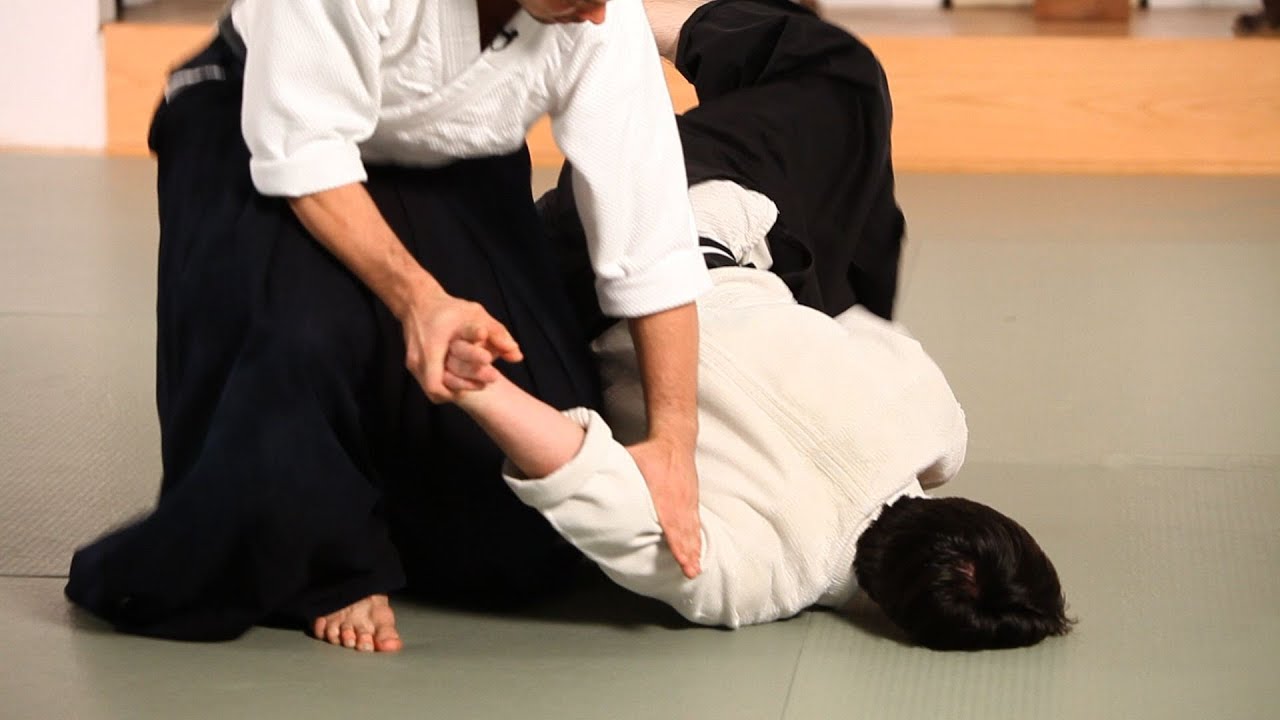
Another classic we might refer to as the “elbow straightener.” You may have noticed that when most people stand upright allowing their arms to dangle along their sides, a slight bend is discernible in the elbow joint. This is actually an unnatural condition. Hence, the appropriateness of the “elbow straightening” therapy. You are being pinned in ikkyo with your arm outstretched to the side. However, that impertinent little bend in your elbow is now blatantly exposed. Fear not, the cure is fast, sharp and simple (and, perhaps, a bit painful, but after all, you are a man, aren’t you?). The self‐appointed dojo “chiropractor” proceeds to immobilize your wrist with one hand and jerks suddenly and forcefully downward on your elbow with the other, and crack, it’s gone! First right arm, then left. (Caution: eating may be a bit difficult for a few days after the intervention.)
Another method I regard with particular fondness involves an “embrace.” The object of your disaffection is executing iriminage and proceeds to lock your head in a vigorous “embrace.” He steps through powerfully and then lowers his body releasing your head about six inches above the tatami. Soon “bells will be ringing” in your head and the tones may persist for several days.
There are many other such unforgettable techniques employed that are equally inventive. Space prohibits me from lengthening the list. The rationalizations for this type of brutality are also imaginative ‐ in fact you wouldn’t believe them: “It was an accident!” “I didn’t know your shoulder was already injured!” “If you’re not a man, you shouldn’t be on the mat.” “He really likes you, otherwise he wouldn’t have given you such special attention!”
The most plausible excuse I have heard offered goes something like this: “When two people are training vigorously injuries do occasionally occur and it is unfortunately a part of serious aikido practice.” The problem is, of course, that one of the “two people,” the one responsible for the injury is consistently the same person and the word “occasionally” would be more accurately replaced by “frequently.”
There is another dimension surrounding this controversial topic which I find totally unfathomable. That is the lack of a feeling of remorse I have seen after our oft‐alluded‐to “resident cruncher” has notched up yet another victim. Although I might be accused of “mind reading” in this case, what other conclusion is possible when this behavior is repeated over and over again?
They are any number of techniques in aikido when one finds himself completely at the mercy of his partner with a joint exposed in a defenseless position. To intentionally abuse this tacit trust that must exist between training partners is something I find absolutely criminal. I personally know of several cases where individuals have suffered severe injuries on the mat and terminated their training careers prematurely rather than run the risk of sustaining a potentially disabling second injury. Further, I cannot for the life of me understand why teachers in charge of dojos where this sort of thing goes on don’t take steps to control or exclude these “crunchers.” It seems that the leaders of the aikido world have by and large failed to recognize that such brutality exists and have made little effort to put a stop to such conduct.
Further reading – Aikido and Injuries: Special Report by Fumiaki Shishida
https://aikidojournal.com/2012/05/30/aikido-and-injuries-special-report/
 TAKEMUSU AIKIDO ONLINE DOJO